
How big is your impact on the planet? This free climate calculator from MAKES Pakistan estimates your yearly carbon footprint in tonnes of CO₂-equivalent. It covers travel, home energy, food, water, sanitation and waste, then compares your result with the Pakistan average and the world average. The quick score takes 30 seconds, and the optional full audit gives a more precise number.
Climate Footprint Calculator
Find your yearly carbon footprint in 30 seconds and see how you compare with your country and the world.
1Profile & location
2How do you usually travel?
3What do you eat?
4Where do you live?
🔍 Want a precise result?
Answer the full audit covering flights, electricity, gas, generator, food waste, water & sanitation, and shopping.
📊 Happy with this?
Go straight to your climate dashboard with a breakdown, tree offsets and tips to reduce your footprint.
Full climate audit
Your quick answers are already filled in. Adjust anything that isn’t right.
🚗 A. Travel
🏠 B. Home energy
🍽️ C. Food
💧 D. Water, sanitation & waste
How you compare
Where your emissions come from
Your top ways to cut emissions
What Is a Carbon Footprint?
A carbon footprint is the total amount of greenhouse gas released by the things you do in a year: driving, using electricity and gas, the food you eat, the products you buy and even the sewage your home produces. Gases such as methane and nitrous oxide are converted into carbon dioxide equivalent (CO₂e), so everything can be added up in one simple number.
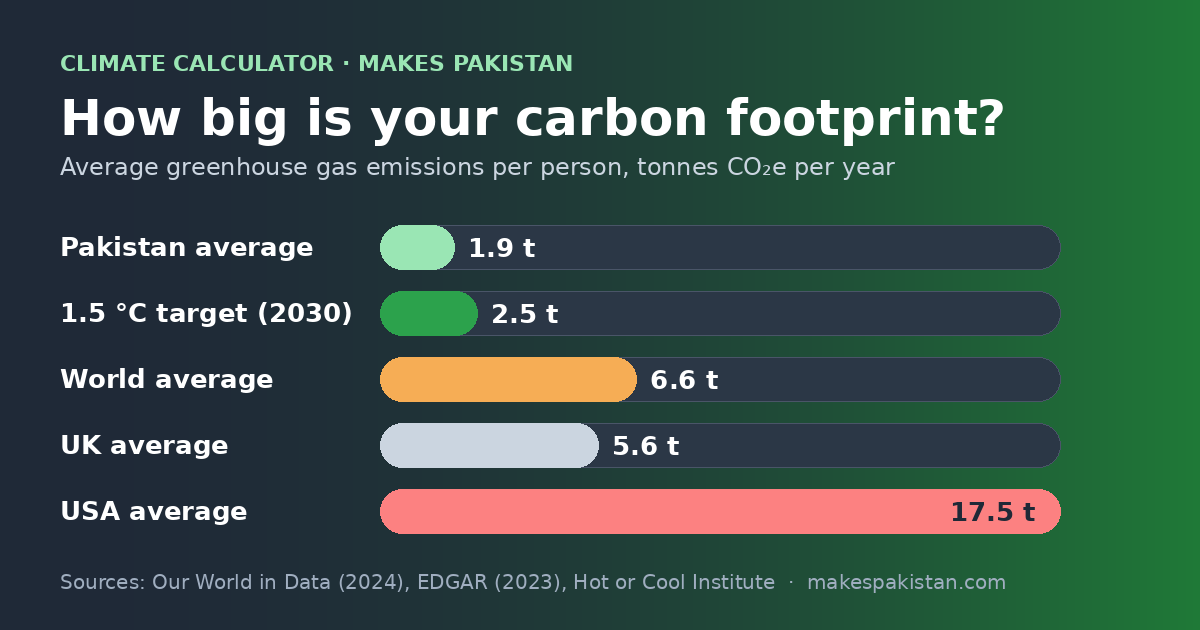
In Pakistan, total greenhouse gas emissions average about 1.9 tonnes per person a year, according to Our World in Data, while the global average is about 6.6 tonnes. To keep warming to 1.5 °C, researchers suggest lifestyle footprints need to fall to around 2.5 tonnes per person by 2030. Urban households with a car, air conditioning and regular flights often land well above the national average, while rising heat and floods make climate adaptation in Pakistan just as urgent as cutting emissions.
How This Climate Calculator Works
The tool has two levels, so you can choose between speed and precision:
- Quick score: three taps (travel, diet and home) plus your country give an estimate in about 30 seconds.
- Full audit: 18 questions on driving distance, flights, electricity units, solar, Sui gas or LPG, generator fuel, food waste, water use, sanitation, rubbish and shopping.
Each answer is multiplied by a published emission factor. Electricity uses the carbon intensity of your country’s grid from Ember, so the same bill gives a lower result where more power comes from hydro, nuclear or solar. Fuel and transport factors follow the UK government’s DESNZ conversion factors, including emissions from producing the fuel. Diet values come from a large University of Oxford study, and sanitation methane follows the IPCC 2019 guidelines.
Understanding Your Result
- 2.5 t or less: climate champion, already in line with a 1.5 °C lifestyle.
- Below 6.6 t: below the world average, although probably still above the Pakistan average.
- 6.6 to 10 t: moderate impact, with clear room to improve.
- Above 10 t: high impact. Flights, large homes and heavy car use are the usual causes.
Your dashboard also shows how many trees would need to grow for a year to absorb your emissions (about 22 kg of CO₂ per tree), how much wastewater your household creates, and which categories add the most to your total.
Why Wastewater and Sanitation Matter for the Climate
Sewage that sits in septic tanks, open drains or untreated ponds breaks down without oxygen and releases methane, a greenhouse gas about 27 times more powerful than CO₂ over 100 years. The amount per person is small, but across a city of millions it adds up quickly, and untreated sewage also pollutes rivers, canals and groundwater.
Nature-based systems such as constructed wetlands and biogas digesters cut these emissions, use very little electricity and produce water that can be reused for irrigation. That is why our footprint tool includes a sanitation question, and why MAKES Pakistan designs constructed wetlands, wastewater treatment plants and biogas systems across the country.
8 Practical Ways to Cut Your Footprint in Pakistan
- Install rooftop solar to reduce grid electricity and generator use.
- Set inverter ACs to 26 °C and switch to LED lights and efficient fans.
- Car-pool, combine errands and use public transport where possible.
- Fly less, and choose direct flights when you must travel.
- Eat beef and mutton less often, and plan meals to reduce food waste.
- Insulate your geyser and use a timer during winter.
- Never burn rubbish; separate recyclables and compost kitchen waste for kitchen gardening.
- Connect to proper sewage treatment, such as a reed bed system, or a biogas unit instead of an open drain.
Frequently Asked Questions
Is this climate calculator free to use?
Yes. It is completely free, needs no sign-up and runs in your browser. Your answers are not stored unless you choose to send your report to our team.
How accurate is the result?
It is an estimate based on published average emission factors. In our tests it came within about 10% of a leading online footprint calculator for the same household. For a certified figure, you need a full carbon audit using real bills and fuel records.
What is the average carbon footprint in Pakistan?
About 1.9 tonnes of CO₂e per person per year (Our World in Data, 2024), far below the world average of roughly 6.6 tonnes. Footprints vary widely between rural and urban households.
Why is my score higher than the Pakistan average?
The national average includes millions of people who do not own a car, fly or use air conditioning. If you drive daily, run an AC or travel by air, your personal footprint can be several times the national figure.
Does wastewater really affect my carbon footprint?
Yes. Septic tanks, open drains and untreated sewage release methane. The effect is about 0.1 tonnes per person each year, but it becomes large across a whole city. Treatment systems such as constructed wetlands reduce it significantly.
How many trees do I need to offset my footprint?
A growing tree absorbs roughly 22 kg of CO₂ a year, so a 5-tonne footprint needs about 230 trees. Cutting emissions first is more effective than relying on offsets alone.
Can MAKES Pakistan help my organisation reduce emissions?
Yes. We advise homes, housing societies, schools, industries and government departments on wastewater treatment, biogas, solar integration and solid waste management. Contact us or call 0300-3233687 for a free consultation, or meet our panel of experts.